Paul Smith performs research, analysis, and communication in the fields of Sustainable Agriculture, Environment, and Public Policy. Thoughtful, nuanced analysis of issues and data. Recommendations and conclusions that reflect perspectives beyond the conventional. Examples provided here are from current and previous work and employment.
WHAT’S NEW

Benchmarking soil health in glaciated soils under grain and oilseed production - Geoderma
Quantifying soil health on agricultural lands has become a global priority, yet it remains unclear how much management practices have improved soil functioning on commercial farms, or how much potential for improvement remains. Reference-based benchmarking, by comparing row-cropped soils to undisturbed perennial soils, offers one approach for addressing this. Our objectives were to (1) determine the maximum soil health potential for soils under row crop production, (2) quantify the effects of management practices, and (3) assess progress toward soil health potential under improved management. We sampled 262 soils from the Greater Golden Horseshoe region in Ontario, Canada: 160 from grains and oilseeds, and 102 from perennials undisturbed by cultivation (> 10 years) to represent references. Soil measurements included texture, pH, organic carbon, aggregate stability, and potentially mineralizable carbon. Multiple linear regression was used to evaluate effects of management and inherent soil properties on soil health indicators, and logistic regression was used to estimate the probability of reaching a hypothetical goal relative to the potential for each indicator. Decreased soil disturbance, cover crops, and presence of winter wheat (Triticum aestivum L.) in rotation were the factors that improved aggregate stability. Manure additions and cover crops were the factors that improved potentially mineralizable carbon. The probability of approaching a goal of 75% of the reference aggregate stability value increased from 0.36 (conventional) to 0.76 (no-till and cover crops). By comparing management with respect to soil, our approach quantifies progress achieved by farmers and the potential for improvement to enable soil health interpretations.
www.sciencedirect.com

Feb 2026 - Comparing Soil Health Assessment Frameworks to Strengthen Ontario’s Soil Health Assessment and Plan - Greenbelt Foundation
The Greenbelt Foundation, in partnership with the Soil Health Institute, has released a recommendations report for soil health assessment frameworks. Using
greenbelt.ca

Nov 2025 - Regional Soil Health Report - Greenbelt Foundation
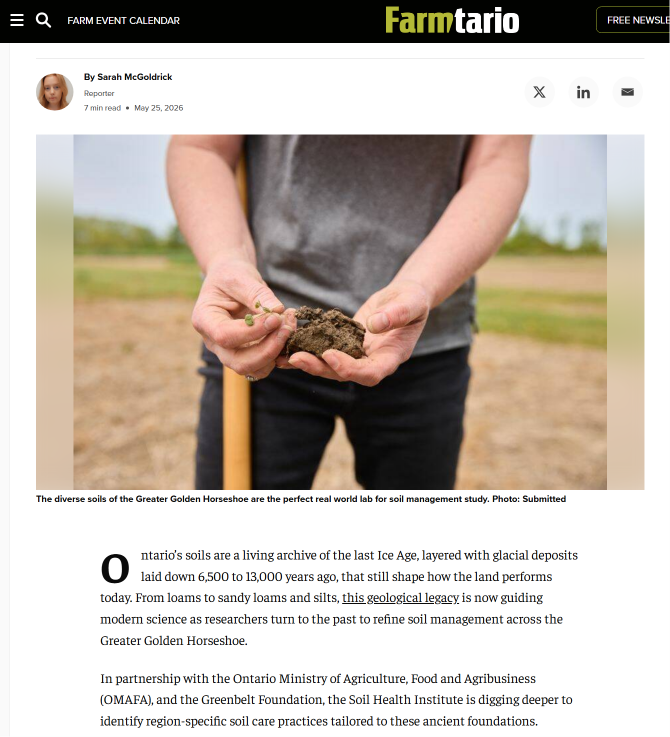
Field sampling at 264 locations across the Greater Golden Horseshoe shows that soil-health practices deliver consistent benefits. Compared with baseline management, sites using reduced tillage, cover crops, and living roots achieved better aggregate stability, higher organic matter, and greater available water. Reference sites with very little disturbance performed best, setting an aspirational benchmark. These results link everyday practices to outcomes that matter, including fewer problems in wet springs, better drought tolerance, and more reliable yields. The report translates indicators into clear guidance and highlights actions farmers can take now to strengthen soil function and manage risk.
greenbelt.ca
Recent curated podcast episodes of the Food Farm Talk radio show aired on CFRU 93.3 FM are available at:

Developing a National Soil Health Strategy
The National Soil Health Strategy (NSHS) is a pivotal initiative aimed at advancing soil health, fostering sustainable agricultural practices, and ensuring environmental resilience for Canada…
To Batoche and Back: Article in book: mihko kiskisiwin at the FriesenPress
Thomas King said, “The truth about stories is . . . stories are all that we are.” Colonization has tried to erase and eradicate Indigenous narratives for centuries. Even mainstream literature features the same kinds of stories told by the same voices.…